


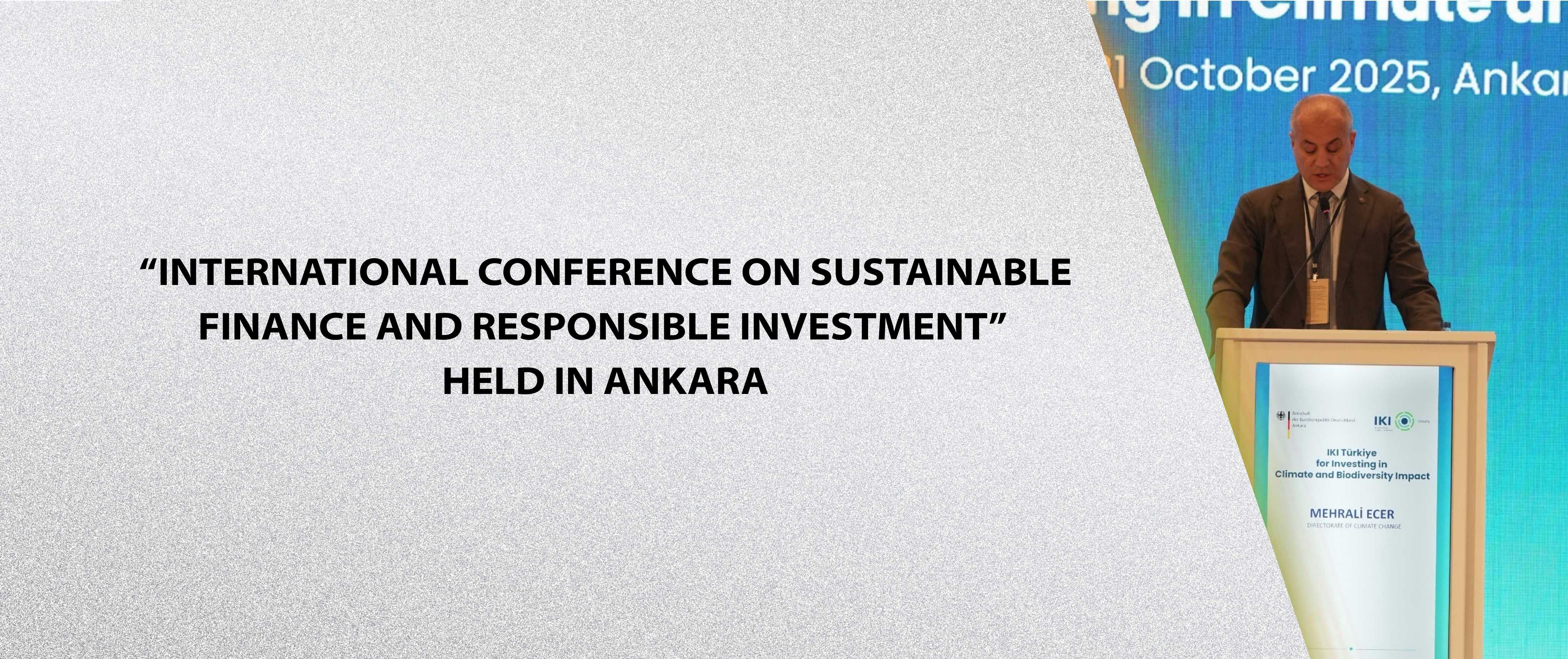
The “International Conference on Sustainable Finance and Responsible Investment” was organized in Ankara, by the German Agency for International Cooperation (GIZ) under the International Climate Initiative (IKI).
23 October 2025
The “International Conference on Sustainable Finance and Responsible Investment” was organized in Ankara, by the German Agency for International Cooperation (GIZ) under the International Climate Initiative (IKI).
Held under the theme “International Climate Initiative – Climate and Biodiversity Investments in Türkiye,” the conference focused on how achieving climate and biodiversity targets depends on scaling up investments across all sectors of the economy and ensuring their long-term sustainability.
The meeting, which highlighted impactful collaborative approaches and innovative financing mechanisms, was attended by Deputy Director of Climate Change Mehrali Ecer.
“Climate-driven adverse effects such as rising temperatures, extreme weather events, droughts, and sea-level rise are being felt more intensely across the globe,” said Ecer, stressing out the growing impacts of climate change worldwide, with disasters becoming both more frequent and more destructive.
“This crisis, which threatens our living spaces, agricultural activities, and overall quality of life, is not merely an environmental issue but also an economic, social, and political one.”
Underscoring the wide-ranging implications of climate change, from energy security and food supply to migration and social stability, Ecer went on to say that “Given its position in the Mediterranean Basin, Türkiye is located in one of the regions most vulnerable to climate change.”
Referring to the steps taken in Türkiye in recent years as part of climate change mitigation efforts, Ecer made the following remarks said his opening speech:
“We have completed the work on our Second Nationally Determined Contribution, which serves as the roadmap for our 2035 target.”
“This year is a critical one, as NDC 3.0 will be submitted. We have completed the work on our Second Nationally Determined Contribution, which serves as the roadmap for our 2035 target. Our distinguished President shared Türkiye’s mitigation target with the international community at the 80th Session of the United Nations General Assembly. For the first time globally, we have developed our Nationally Determined Contribution by integrating climate projections and vulnerability analyses with a model that establishes the scientific basis of our green development and mitigation targets.”
“Climate Law constitutes a comprehensive legislative framework aimed at ensuring an effective and integrated response to climate change.”
This year, our country achieved a major milestone in climate action by enacting its Climate Law. With this step, the necessary legal framework for tackling climate change has been put in place. The Climate Law constitutes a comprehensive legislative framework aimed at ensuring an effective and integrated response to climate change. It is not merely an environmental regulation; it also serves as a roadmap for Türkiye’s economic transformation, sustainable development, and vision for social welfare. Moreover, the Climate Law plays a critical role in achieving the 2053 Net Zero Emissions and Green Development targets. It is also of key importance in ensuring the effective implementation of Türkiye’s Nationally Determined Contributions, strengthening adaptation policies, encouraging low-carbon investments, and developing green finance mechanisms.
“We are preparing climate projections for our country, extending to the year 2100.”
A highly significant project focused on adaptation is currently under way. Within the scope of this project, climate projections for Türkiye extending to the year 2100 are being developed. Thus, we will make the scientific data source available for all climate-related studies to be conducted at the local level in our country. In addition, sector-specific risk and vulnerability analyses will be carried out, helping to build a more climate-resilient environment.”
The program brought together representatives from governmental organizations, the private sector, development partners, non-governmental organizations, and academia.