


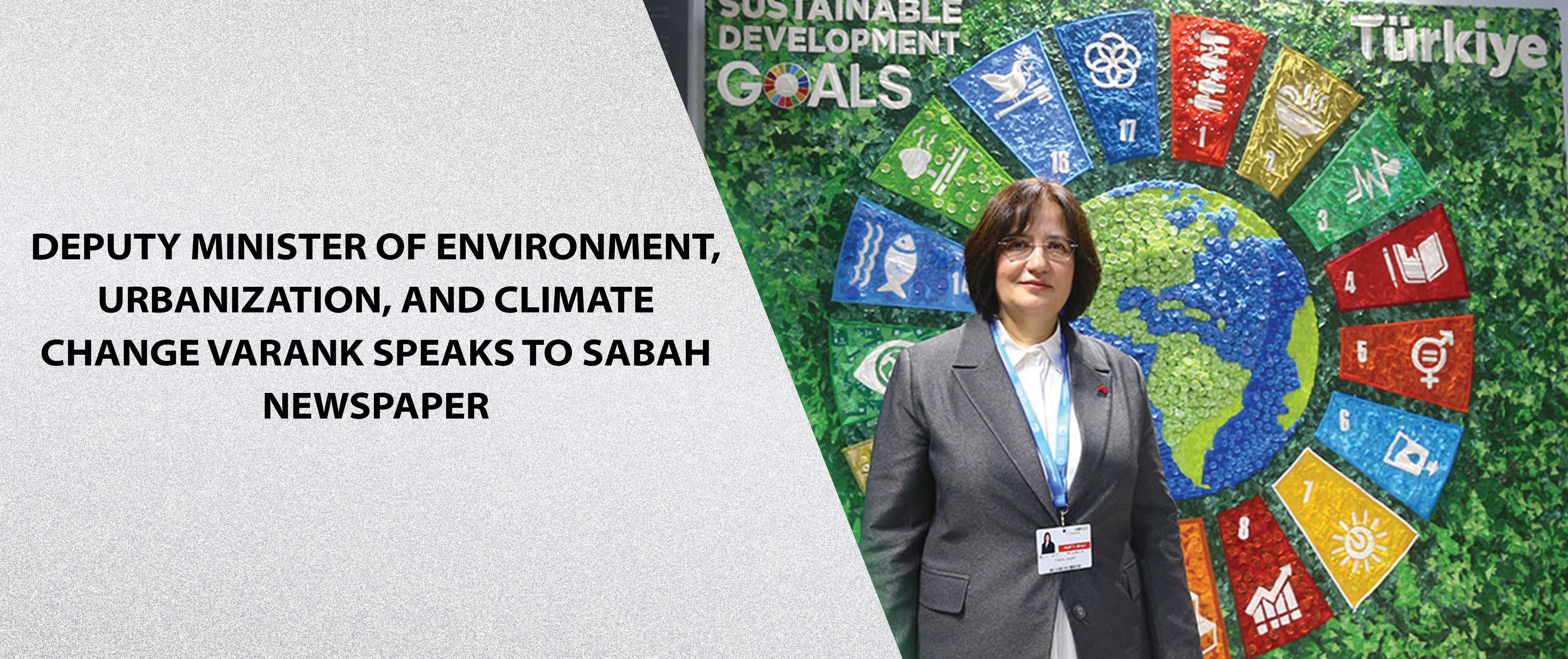
Deputy Minister of Environment, Urbanization, and Climate Change and Climate Change Chief Negotiator Fatma Varank gave an interview to Sabah Newspaper on Türkiye’s COP29 efforts and its candidacy to host COP31.
04 January 2025
Deputy Minister of Environment, Urbanization, and Climate Change and Climate Change Chief Negotiator Fatma Varank gave an interview to Sabah Newspaper on Türkiye’s COP29 efforts and its candidacy to host COP31.
Drawing attention to Türkiye’s pre-COP29 preparations, Deputy Minister Varank said, “By taking part actively in key international meetings held ahead of COP29, Türkiye demonstrated a firm and principled stance in climate negotiations.
Under the leadership of the Ministry of Environment, Urbanization, and Climate Change and the coordination of the Directorate of Climate Change, high-level delegations attended events such as the Copenhagen Climate Ministerial, the Petersberg Climate Dialogue, the United Nations Climate Change Subsidiary Bodies meetings, and the Ministerial on Climate Action.”
Noting that the diplomatic engagements carried out under the leadership of Minister Murat Kurum during Climate Week and the Pre-COP29 meetings held alongside the 79th United Nations General Assembly underscored Türkiye’s effectiveness in this field, Deputy Minister Varank said, “At COP29, a total of 47 negotiators from the Directorate of Climate Change and relevant ministries took an active part for two weeks in negotiations conducted under nearly 180 agenda items. High-level participation was ensured, led by our President Recep Tayyip Erdoğan and his wife Emine Erdoğan. In addition, around 1,800 participants from academia, the business community, the private sector, civil society organizations, and the media attended the conference at their own expense. This broad participation clearly demonstrates the importance Türkiye attaches to the fight against climate change and its commitment to international cooperation.”
Key highlights from Varank’s remarks are as follows:
“Türkiye has once again reaffirmed its commitment to reaching its 2053 Net Zero Emissions target”
Türkiye shared two key documents with the international community. The first was the Biennial Transparency Report prepared under the transparency framework of the Paris Agreement. Türkiye became one of the first countries to submit this report. The second document was Türkiye’s 2053 Long-Term Climate Change Strategy, which sets out the country’s vision for tackling climate change. The document, presented to the global public at a press conference held by Minister Murat Kurum, includes 89 strategies across 18 sectors. Through this document, Türkiye has once again reaffirmed its commitment to reaching its 2053 Net Zero Emissions target.
“Türkiye aims to strengthen the transparency and effectiveness of climate action”
At COP29, our country took part in a wide range of major international initiatives. Türkiye continued to play an active role in international cooperation through initiatives such as the “Green Energy Zones and Corridors”, “Energy Storage and Grids”, the “Global Platform for Decarbonization”, “Reducing Methane from Organic Waste”, the” Baku Harmoniya Climate Initiative for Farmers”, “Green Digital Action”, and “Multisectoral Action Pathways to Resilient and Healthy Cities”.
Through initiatives such as the Baku Global Climate Transparency Platform and the Global Platform for Decarbonization, Türkiye sought to enhance the transparency and effectiveness of climate action.
Key Decisions Taken at COP29
The decisions adopted under the Baku Climate Unity Pact include major steps in the areas of climate finance and adaptation policy. Türkiye’s contributions to the negotiations played a role in ensuring that these decisions are inclusive and implementable.
One of the most notable outcomes of COP29 was the new collective quantified goal on climate finance, which sets a target of mobilizing a total of USD 1.3 trillion per year from all actors by 2035 to meet the needs of developing countries. This new collective target represents a remarkable shift in global climate finance architecture. At its core is an annual financing pillar of USD 300 billion led by developed countries. Furthermore, the “Baku to Belém Roadmap to 1.3T” was launched to clarify the structure and flow of this financing. Within the scope of these negotiations, Türkiye secured a position that allows it to benefit both from existing financial mechanisms and from newly established funding sources. At COP29, the long-awaited Article 6 negotiations, which set the framework for United Nations carbon markets, were also concluded. Through carbon markets, annual financial flows of USD 1 trillion are targeted to support developing countries in achieving their climate goals. This new mechanism aims to provide a major source of financing for greenhouse gas mitigation and climate change adaptation. The operationalization of the Loss and Damage Fund at COP29 also marked a major achievement. At Türkiye’s initiative, adjustments were introduced to make existing financing mechanisms such as the Green Climate Fund and the Global Environment Facility more accessible to developing countries.
“With its strong stance, Türkiye has proven that it is a leader not only regionally but also globally in the fight against climate change”
With its active role and strong stance at COP29, Türkiye once again proven that it is a leading country not only regionally but also globally in the fight against climate change.
Through its mitigation and adaptation strategies, its nationally determined contribution, and its 2053 net zero target, Türkiye has clearly demonstrated its determination to strike a balance between sustainable development and climate action.
Türkiye views this important platform as an opportunity to build bridges between developed and developing countries, promote its green transition vision on the international stage, strengthen climate resilience, and deepen cooperation in the fight against climate change.
Through hosting COP31, Türkiye aims to further advance both its diplomatic and technical contributions to climate negotiations.
“Türkiye continues to work to bequeath future generations a more livable world”
In this process, Türkiye aims to offer a leadership model that encourages international cooperation and solidarity by stepping up climate action, delivering on greenhouse gas reduction targets, and strengthening adaptation policies. The fight against climate change is a shared responsibility not only of states but of all humanity. With this global responsibility in mind, Türkiye continues to roll out innovative, economy-wide solutions. By expanding renewable energy sources such as solar and wind, protecting nature, and implementing projects that lead technological innovation, Türkiye continues to work to bequeath future generations a more livable world.