


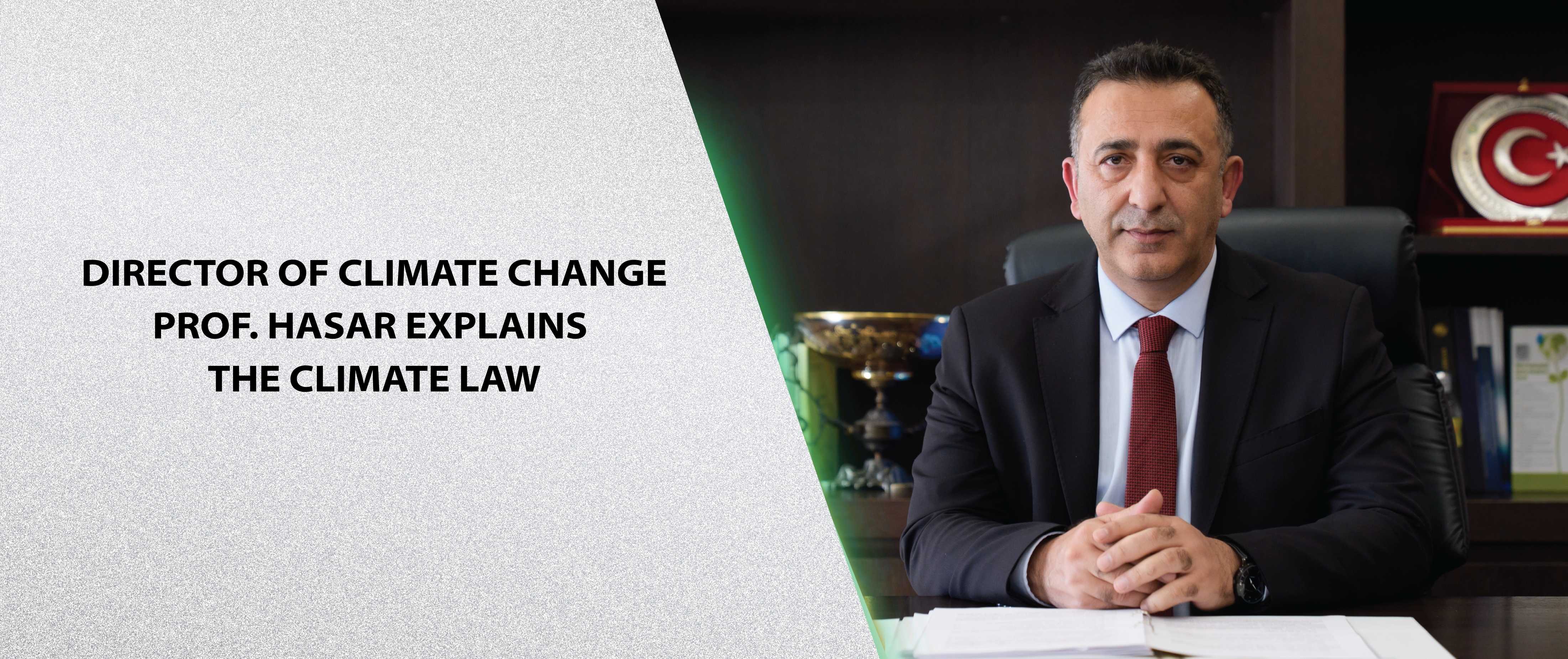
Director of Climate Change Prof. Hasar took part in a webinar organized by the Sustainability Academy and the Sustainable Business Network (SBN), where he outlined the details of the Climate Law and Türkiye’s 2053 Net Zero Emissions target.
27 August 2025
Director of Climate Change Prof. Hasar took part in a webinar organized by the Sustainability Academy and the Sustainable Business Network (SBN), where he outlined the details of the Climate Law and Türkiye’s 2053 Net Zero Emissions target.
In his remarks, Director of Climate Change Prof. Hasar stressed that climate change is not merely an environmental issue, stating, “Climate change is a far-reaching crisis whose impacts are felt across many spheres, from the economy and the social order to global stability and human security.”
The Climate Law’s Core Objective:
2053 Net Zero Emissions and Green Development
Prof. Hasar noted that the Climate Law is built around the twin goals of 2053 Net Zero Emissions and Green Development. Pointing out that Türkiye submits a Nationally Determined Contribution every five years, he said: “Each new submission must reflect greater ambition and stronger resolve than the last. What matters is steady progress and sustained commitment to our targets.”
He added that the Climate Law aims to deliver a comprehensive and effective response to climate change while safeguarding Türkiye’s material and non-material interests, emphasizing that the law is designed to protect not only the environment but also the country’s future and natural resources.
Key Provisions of the Climate Law
Prof. Hasar stated that the Climate Law formally defines the concepts of “Climate Justice” and “Just Transition” for the first time in Türkiye’s legal framework and clarifies institutional structures and the distribution of responsibilities.
Under the law, climate policy implementation rests on two pillars: emissions reduction and climate change adaptation.
All activities will be monitored and reported annually by the Directorate. And the resulting reports will be reviewed by the Climate Change Adaptation Coordination Board before they are made public.
The Climate Law Paves the Way for Voluntary Carbon Credits
Describing finance as a critical pillar of climate negotiations, Prof. Hasar indicated that the Climate Law establishes Türkiye’s Emissions Trading System and enables the implementation of the Carbon Border Adjustment Mechanism.
He also noted that the law opens the door to the use of voluntary carbon credits and said that Türkiye is among the countries in which such credits are being aggregated.
Türkiye's Green Taxonomy Will Be Established
Prof. Hasar said that the Green Taxonomy of Türkiye is currently being developed and added: “With the Green Taxonomy, the framework for sustainable investments will become clear, and financial flows will be steered toward climate-friendly activities. The Climate Law also introduces major steps at the local level. Local Climate Change Action Plans will become mandatory in all 81 provinces. Provincial Climate Change Coordination Boards will be established in each province with the participation of public institutions, the private sector, academia, and civil society. This will allow local challenges to be identified directly and addressed through swift and effective solutions.”
The Emissions Trading System Will Strengthen the Private Sector’s Competitiveness
Prof. Hasar said that the Climate Law will protect industry while ensuring the effective implementation of climate policies. He noted that the Emissions Trading System will strengthen the international competitiveness of the private sector, particularly for industries exporting to the European Union.
“The Emissions Trading System is a critical instrument for strengthening the private sector’s competitiveness at the international level. Green investment is no longer optional; competing globally with outdated technologies is simply not viable. The revenues generated under the ETS will be used to promote green investments. We have studied emissions trading systems in many countries and observed that each model is shaped by national priorities. We have therefore designed our own ETS within a draft regulation prepared together with the private sector and relevant institutions. At the workshop we held on 12 August, we are carefully reviewing the revisions and proposals submitted for the Draft ETS Regulation. Our priority throughout this process has been to secure broad stakeholder input and active participation.”
COP31 Candidacy
Prof. Hasar underlined that Türkiye has formally declared its candidacy to host COP31. “The decision on where COP31 will be held will be taken on the final day of COP30,” he said.
“If no decision is reached, the UN process will come into play. We have already declared our candidacy at the highest level. Türkiye occupies a strategically important position both diplomatically and logistically. As a country with strong growth potential, we attach great importance to hosting COP31 as a platform for advancing global climate action in a fair and ambitious manner.”