


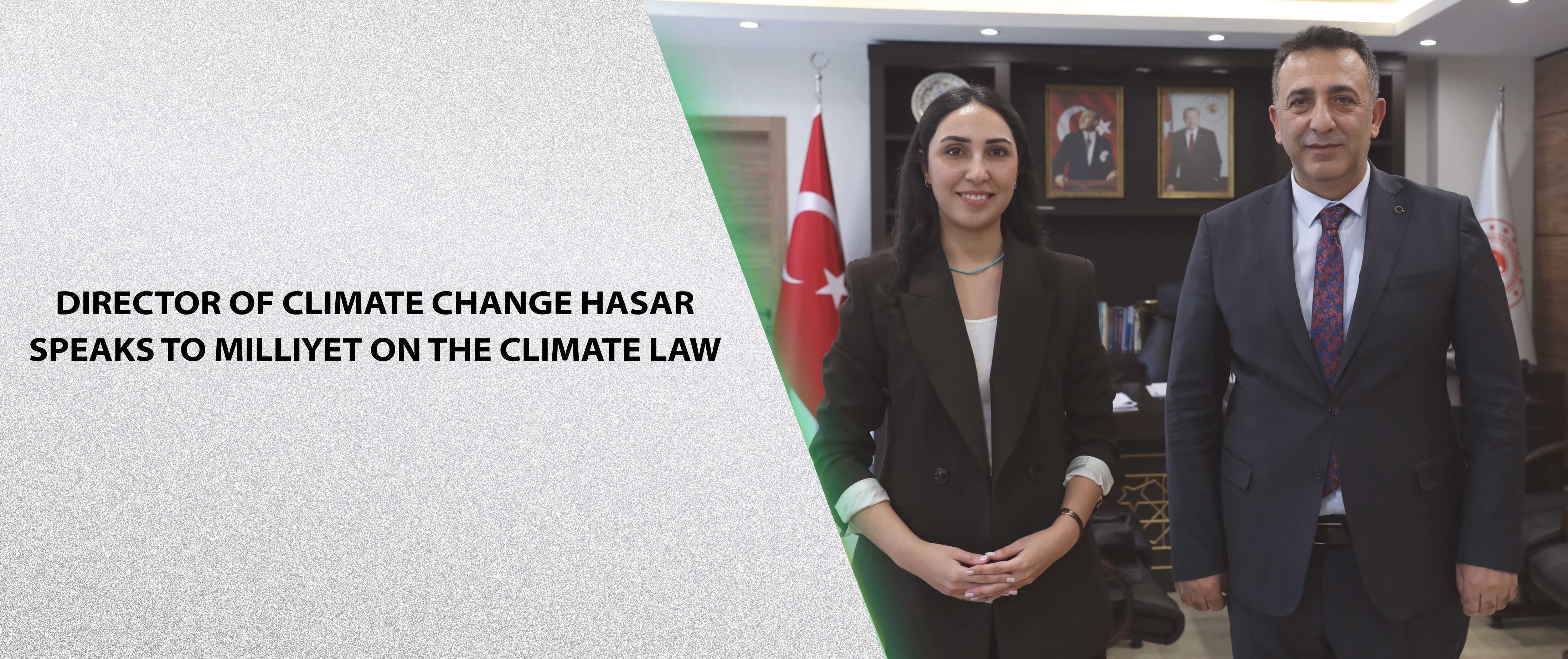
Director of Climate Change Prof. Halil Hasar spoke to Milliyet about Türkiye’s first Climate Law, which is expected to be submitted to the Grand National Assembly this week, addressing the questions most frequently raised by the public.
05 March 2025
Director of Climate Change Prof. Halil Hasar spoke to Milliyet about Türkiye’s first Climate Law, which is expected to be submitted to the Grand National Assembly this week, addressing the questions most frequently raised by the public. Hasar underlined that the Climate Law will safeguard organic agriculture, food security, and water resources, stressing that the legislation will also protect the right to life of even unborn children. Noting that the impacts of climate change are now being felt around the world at varying degrees, Director Hasar made the following remarks in his interview with Milliyet:
“Türkiye can serve as a global arbitrator in climate diplomacy”
Türkiye occupies a central position geopolitically, in climate policy, and in economic terms. It stands among the few countries capable of understanding and empathizing with both developed and developing nations. We believe that Türkiye can serve as a global arbitrator in climate diplomacy. Guided by this vision, we have put forward our candidacy to host COP31 and to bring climate negotiations to Türkiye.
“The law will ensure food security, protect water resources, and promote organic agriculture, livestock farming, afforestation, and the expansion of green areas"
Through the Climate Law, Türkiye must prepare its society for climate change in vital, environmental, and economic terms. Within this framework, all institutions, organizations, ministries, local and central administrations, financial bodies, and other stakeholders will assume clearly defined responsibilities. All of these issues are closely interconnected. From household employment to agricultural policy, ensuring food security, protecting water resources, promoting organic agriculture and livestock farming, restoring deforested areas to forest status, expanding urban green spaces, and accessing financial resources, all of these elements come together under a single comprehensive framework.
“This law protects the right to life of unborn children”
Under this law, every institution and organization must fulfill its responsibilities. This law protects the right to life of unborn children. It will not only contribute to reducing greenhouse gas emissions. Adaptation measures will also move to the forefront. Early warning systems will play a critical role. We are planning for where and how potential risks may arise—whether in the form of heat waves, or floods. We also factor in scenarios extending to avalanche formation.
“We will fully align our development trajectory with green growth”
We have set a net zero emissions target for 2053. We will reach this goal by taking the necessary steps through to 2053. We will achieve this through green growth. We will fully align our development trajectory with green growth. This will clearly usher in a system in Türkiye that is entirely oriented toward clean technologies. The Climate Law establishes this framework. The law does not say, “Let us bring our emissions to zero overnight.” It sets out a realistic pathway.
Türkiye’s Green Taxonomy is under development
Addressing climate change requires substantial financial resources. To accelerate capital flows, we are building a Türkiye-specific system. This would be the Green Taxonomy of Türkiye. It is a comprehensive framework whose threshold values align with the EU taxonomy. Investments that comply with this taxonomy will receive formal certification. This carries international weight. From now on, all new investments must be climate-sensitive and environmentally responsible. They will also benefit from expanded access to concessional financing opportunities.