


Murat Kurum, the Minister of Environment, Urbanization and Climate Change, released a statement on Türkiye’s upcoming role as host and president of the 31st session of the Conference of the Parties.

24 November 2025
Murat Kurum, the Minister of Environment, Urbanization and Climate Change, released a statement on Türkiye’s upcoming role as host and president of the 31st session of the Conference of the Parties (COP31). Accompanying a summary of Türkiye’s key actions in combating climate change, Minister Kurum posted a message: “After the groundbreaking decisions we put into effect over the last 21 years, our struggle against climate change has been crowned with Türkiye hosting the COP31 Conference of the Parties. With those historic steps, Türkiye has taken the wheel of one of the world’s most influential platforms shaping global environmental policies and has become a global actor that not only keeps pace but provides guidance in combating climate change.” Türkiye’s climate action, which began with the signing of the UNFCCC in 2004, gained momentum in 2021 when President Recep Tayyip Erdoğan announced the country’s 2053 Net Zero Emission Target. The shuttle diplomacy carried out over the last two years to secure the COP31 presidency concluded in Türkiye’s favor following five days of negotiations in Brazil.
Hosting the 31st Conference of the Parties to the UN Framework Convention on Climate Change (UNFCCC) represents a major milestone for Türkiye, both in terms of global visibility and in gaining a decisive position in climate diplomacy. The Conferences of the Parties is attended annually by 196 countries. It plays a vital role in charting the global response to the climate crisis, as the sessions focus on establishing targets for greenhouse gas reductions, adaptation policies, climate finance, loss and damage mechanisms, and the rules governing carbon markets. The implementation rules of the Paris Agreement are also shaped during these meetings.
MINISTER KURUM: TÜRKİYE HAS BECOME A GUIDING GLOBAL ACTOR
In a message outlining Türkiye’s achievements in combating climate change, Minister of Environment, Urbanization and Climate Change Murat Kurum wrote: “After the groundbreaking decisions we put into effect over the last 21 years, our struggle against climate change has been crowned with Türkiye hosting the COP31 Conference of the Parties.” With those historic steps, Türkiye has taken the wheel of one of the world’s most influential platforms shaping global environmental policies and has become a global actor that not only keeps pace but provides guidance in combating climate change.”
A HISTORIC SIGNATURE ON THE UNFCCC IN 2004
Türkiye’s determined steps in combating the climate crisis date back to 2004. On 4 May 2004, Türkiye became a Party to the UNFCCC, which had originally entered into force on 21 March 1994. And in 2009, it joined the Kyoto Protocol. Türkiye signed the Paris Climate Agreement as a “developing country” on 22 April 2016 during the High-Level Signing Ceremony held in New York with the participation of 175 countries. The Paris Agreement, which has been adopted to date by 195 Parties (194 States and the European Union), is designed to govern the climate regime following the end of the Kyoto Protocol in 2020.
WHY THE PARIS AGREEMENT?
The Paris Agreement established a legally binding international framework to keep the rise in global average temperature well below 2 °C compared to pre-industrial levels, and ideally limit it to 1.5 °C. Built on a five-year cycle of increasingly ambitious national climate actions, the Agreement requires countries to submit Nationally Determined Contributions (NDCs) every five years.
2053 NET ZERO EMISSION TARGET AND THE CLIMATE COUNCIL
Following President Erdoğan’s announcement of the 2053 Net Zero Emission Target, Türkiye’s first Climate Council was held from 21 to 25 February 2022 by the Ministry of Environment, Urbanization, and Climate Change to set out the building blocks of Türkiye’s long-term climate roadmap in consultation with all stakeholders. Approximately 5,000 representatives from the public and private sectors, universities, NGOs, and student groups attended the Council. Following the meeting, a roadmap guiding Turkey's long-term climate change policies was established through a total of 217 recommendations, 76 of which were prioritized. This roadmap laid the groundwork for the Climate Law, NDCs, the Climate Change Mitigation Strategy and Action Plan, and the Long-Term Climate Change Strategy.
“CLIMATE CHANGE” ADDED TO THE MINISTRY’S NAME
The 12th Development Plan (2024–2028) also included measures under the heading “Environmental Protection” to reduce greenhouse gas emissions and strengthen climate adaptation efforts in line with the Paris Agreement and Türkiye’s Nationally Determined Contribution, while taking national circumstances into account. The 2024–2026 Medium-Term Program outlined a series of objectives to support emission reductions within the broader framework of the green transition and the 2053 Net Zero Emission Target. Subsequently, climate policy coordination was assigned to the Directorate of Climate Change. And with the same decree, the Ministry was renamed the Ministry of Environment, Urbanization, and Climate Change. The Climate Change and Air Management Coordination Board (İDHYKK) was replaced by the Climate Change and Adaptation Coordination Board (İDUKK).
NATIONALLY DETERMINED CONTRIBUTIONS SUBMITTED
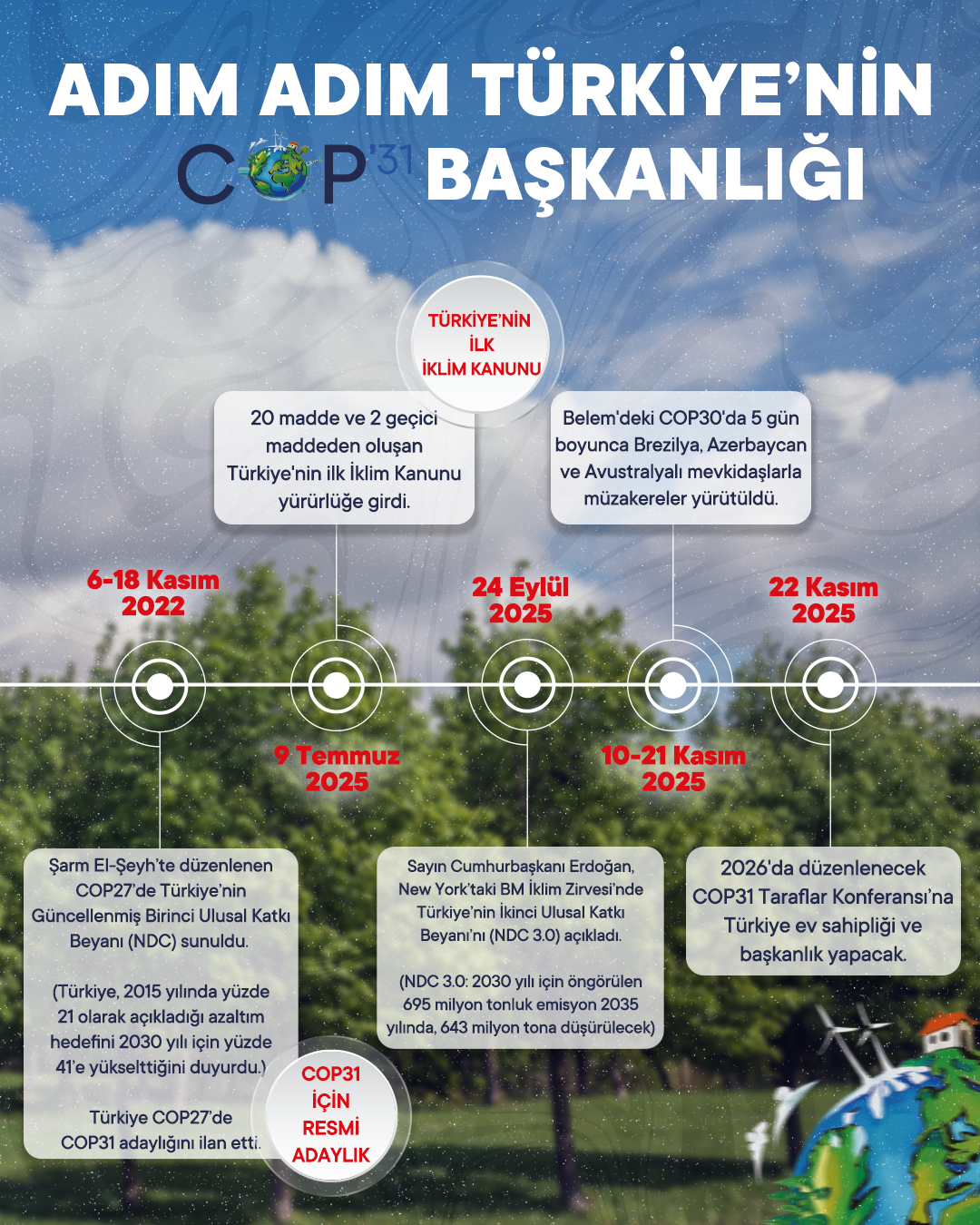
At the 27th session of the Conference of the Parties (COP27), which was held in Sharm El Sheikh from 6–18 November 2022, Minister Kurum presented Türkiye’s Updated First Nationally Determined Contribution (NDC). Türkiye announced that it had raised its previous 21 percent reduction target to a 41 percent reduction by 2030. Türkiye’s Second Nationally Determined Contribution (NDC 3.0), announced by President Erdoğan during the Climate Summit in New York on 24 September 2025, was submitted to the UNFCCC Secretariat. Under the new submission, Türkiye pledged to reduce emissions by 466 million tons of CO² equivalent by 2035 compared to the reference scenario and to limit emissions to 643 million tons of CO² equivalent.
TÜRKİYE’S FIRST CLIMATE LAW
Within the framework of its NDCs and 2053 Net Zero Emission Target, Türkiye took a landmark step by adopting its first Climate Law. On July 9, 2025, Turkey's first Climate Law, consisting of 20 articles and 2 transitional provisions, came into force. The Law covers the reduction of greenhouse gas emissions and climate change adaptation activities, which are fundamental in combating climate change, as well as the planning and implementation tools, revenues, permits and inspections, and legal and institutional framework related to these areas. By adopting the Climate Law, Türkiye demonstrated its firm determination to combat climate change, transforming its long-standing aspiration to preside over the Conference of the Parties into reality under Minister Kurum’s leadership.
THE FIRST STEP TOWARD THE COP PRESIDENCY WAS TAKEN IN 2022
Türkiye announced its candidacy for hosting the COP31 during COP27 in Sharm El Sheikh in 2022. Australia, a fellow member of the UN’s Western European and Others Group (WEOG), also submitted a candidacy. The two countries engaged in friendly negotiations for nearly two years. Minister Kurum carried out shuttle diplomacy with Australian Minister for Climate Change and Energy Chris Bowen and Azerbaijan’s Special Presidential Envoy for Climate Change and COP29 President Mukhtar Babayev. The three countries held friendly discussions, meeting online, in person, and during international summits. At these gatherings, Minister Kurum underscored that Türkiye was fully prepared to host COP31, both logistically and in terms of human resources. He also stressed that Türkiye seeks to guide the process in a way that strengthens the green transition by building a bridge between developed and developing countries. The Parties later convened again on 22 September in New York during the 80th Session of the United Nations General Assembly.
INTENSE NEGOTIATIONS WITH AUSTRALIA IN BELÉM
The process concluded at COP30, which began on 10 November in Belém, Brazil. Representing Türkiye in the negotiations for the COP31 presidency and hosting, Minister Kurum spent a week in discussions with Brazil, Azerbaijan, and Australia. During the negotiations, Minister Kurum referenced the historic Turkish–Anzac friendship rooted in Çanakkale, emphasizing that this shared spirit could guide a united global response to the climate crisis. He emphasized that Türkiye, situated in the Mediterranean basin and deeply affected by climate change, bears far less historical responsibility than many developed nations, yet continues to take decisive climate action. Minister Kurum emphasized that Türkiye is a leading global actor in climate action and is prepared to share its expertise while taking a leadership role in multilateral climate diplomacy. He also noted that Türkiye is advancing resolutely toward its 2053 Net Zero Emission Target through the Climate Law, the Zero Waste Movement, circular economy initiatives, and a diverse portfolio of renewable energy sources, serving as a model in the field.
LEADERS OF 196 COUNTRIES WILL GATHER IN TÜRKİYE
After two years of diplomatic traffic and five days of negotiations, Türkiye’s campaign was successful. It was decided that the COP31 Conference of the Parties, including the World Leaders Summit, will be hosted and presided over by Türkiye next year. A consensus was reached that Australia would be appointed by the COP31 President to provide support solely in the capacity of “President of Negotiations” during the negotiation processes. It was also agreed that the Pre-COP meeting would be held in a Pacific country under Australia’s leadership. Türkiye secured the presidency with its commitment to “a more just and inclusive diplomacy where no country is left behind.” Marking a historic diplomatic achievement, Türkiye will host the COP for the first time, the UN’s most significant platform in the fight against climate change. Türkiye will serve as a bridge between developing countries and advanced economies during the sessions. Leaders from 196 countries will convene in Türkiye to discuss their commitments, policies, and solutions to address the climate crisis.
HOSTING A COP CARRIES GLOBAL PRESTIGE
Hosting a COP holds global significance, offering countries enhanced international visibility and a decisive role in climate diplomacy. During COP meetings, countries set targets for greenhouse gas reductions, adaptation strategies, climate finance, loss and damage mechanisms, and the rules governing carbon markets. Hosting also delivers diplomatic, economic, and environmental benefits. By hosting a COP, a country gains significant diplomatic visibility by positioning itself at the center of global climate policy. The presence of tens of thousands of delegates generates substantial economic activity across tourism, accommodation, transportation, and service sectors. The process simultaneously accelerates the host country’s green transition efforts. Renewable energy, sustainable urban development, and climate adaptation projects gain stronger visibility on the national agenda. Interest from international financial institutions and climate funds increases, while the country gains greater potential to attract investments in clean energy and climate finance. Moreover, the host city becomes “center of climate diplomacy” for two weeks, capturing the world’s attention and strengthening its international profile.